

Privacy and free speech advocates warn that device-level age verification could chill lawful speech and pave the way for digital ID.
TALLAHASSEE, Fla. – Florida Attorney General James Uthmeier has proposed requiring age verification in app stores, operating systems, and AI chatbots, turning child protection into a system that identifies every user.
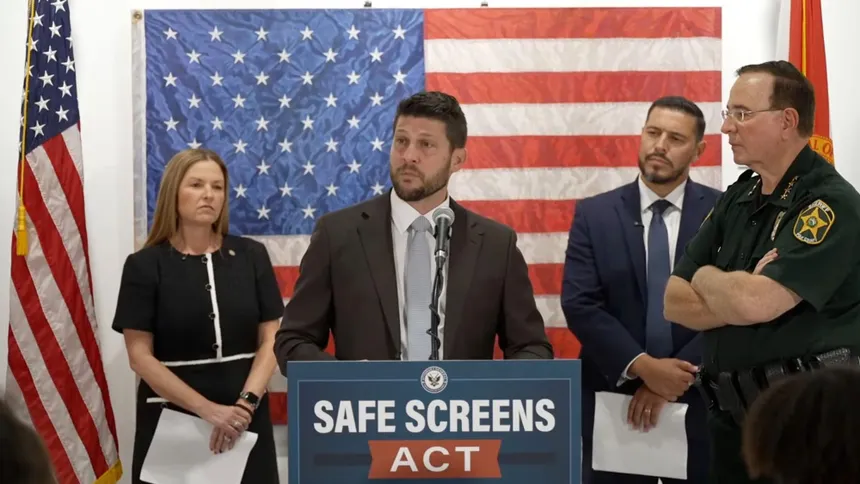
The "Safe Screens Act" was announced at Polk State College in Winter Haven, with Polk County Sheriff Grady Judd and education leaders. App stores would have to determine users' ages, link minors to a parent's account, and obtain parental consent before a minor downloads or buys an app. Operating systems would have to apply age-based restrictions at the device level, and AI chatbot operators would have to determine account holders' ages.
Teens aged 14 to 17 would face overnight and school-hours "quiet mode," a cap of two hours a day and 60 hours a month on social media, and autoplay and infinite scroll switched off unless a parent enables them. Chatbots would be barred from offering minors features that simulate companionship. Violations would carry fines of up to $50,000 each.
The privacy problem
The proposal requires "commercially reasonable, privacy-protective methods" but names none, according to Reclaim The Net. Critics say there is no way to find the minors without checking everyone.
Digital rights groups argue that collecting ID online ties everything a person says or does to an ID and creates a record, which can chill free speech and violate the First Amendment.
Anonymity is also at stake. Requiring identification to access lawful content discourages some people from reading, posting, or searching altogether, which critics say chills speech. The Computer and Communications Industry Association warned that an Eleventh Circuit ruling upholding Florida's under-14 social media ban "risks imposing identity authentication on Floridian internet users of all ages." In a dissent, Judge Robin Rosenbaum wrote that the law effectively links users' identities, and their parents' identities, to their social media accounts.
Additionally, companies and systems that collect IDs online have proven themselves untrustworthy. Reclaim The Net notes that a Discord experiment with government ID age checks ended in a breach exposing more than 70,000 IDs.
Digital ID
Some critics see a larger destination. If every device and app store must establish who is a minor, they argue, the practical way to do it at scale is a trusted credential tied to a real-world identity. They warn that a mandatory identity layer for ordinary computing is the foundation of a digital ID system, and that once it exists, it can be extended to track, score, and restrict people. China is the cautionary example they most often cite.
Privacy advocates note that the same pattern has played out elsewhere: a narrow child-safety rule, then an identity requirement, then an expansion of what the credential is used for.
A pattern of escalation
Florida has asked courts to order age checks at Meta and OpenAI, and sued Discord on October 16. On October 14, the Eleventh Circuit let the state's under-14 ban take effect, describing it as a "conditional ban" rather than an outright prohibition. Those cases targeted individual companies. The new proposal would apply to the devices and stores everyone uses.
The proposal has not been introduced as a bill, and only a legislator can file one. The 2027 session begins March 2. Uthmeier faces Democratic challenger José Javier Rodríguez in the November 3 election.
Sources: Reclaim The Net (Oct. 23, 2026); Electronic Frontier Foundation.
